


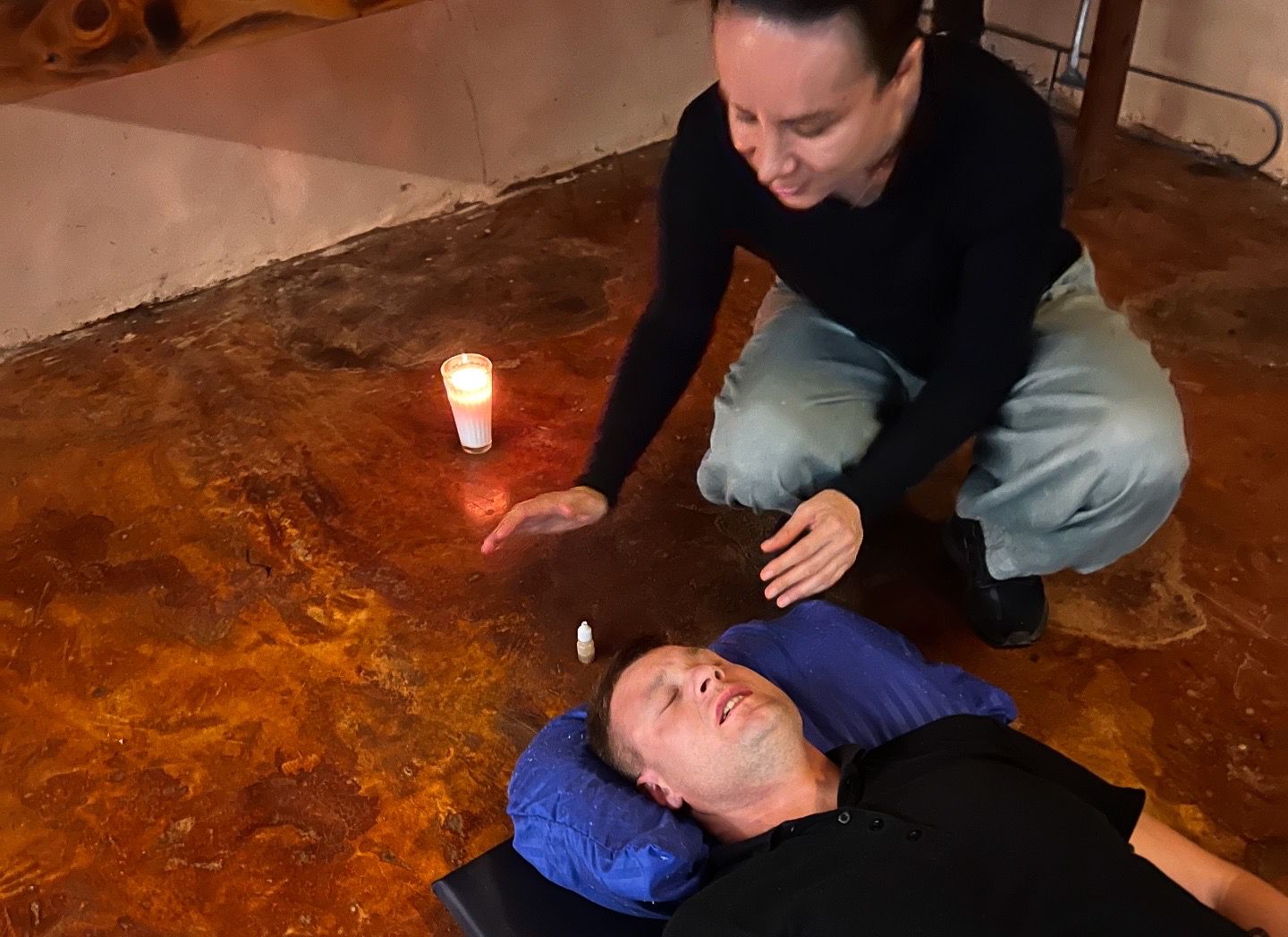
Sananga – The Medicine of Inner Vision, Presence & Conscious Awareness
An Amazonian plant preparation, spiritual clarity, and the journey toward deeper self-awareness
Within Amazonian spiritual traditions, plants hold significance not only as part of the natural world but also as symbols of the connection between humanity, nature, consciousness, and spiritual understanding.
One traditional plant preparation is Sananga, commonly known as Amazonian eye drops.
Sananga is associated with certain Indigenous communities of the Amazon, where it has been used in traditional and ceremonial contexts.
Its application is known for producing an intense burning sensation in the eyes, which may trigger strong physical and emotional reactions.
In contemporary spiritual settings, Sananga is sometimes associated with clarity, focus, presence, and inner vision.
At Healing Ceremonies Mexico, we approach Sananga as a traditional ceremonial preparation, not as a medicine intended to treat or cure eye conditions.
From a spiritual perspective, we are particularly interested in the relationship between perception, the mind, and our ability to remain consciously present.
What Is Sananga?
Sananga is a plant preparation made from certain Amazonian plants belonging to the Tabernaemontana genus.
Species commonly mentioned include Tabernaemontana sananho and Tabernaemontana undulata, although the precise composition and traditional preparation methods may vary.
Plants within this genus contain various naturally occurring alkaloids whose properties are of scientific interest.
However, this does not mean that the safety or therapeutic effectiveness of traditional Sananga eye drops has been clinically established.
Sananga is not a classic psychedelic medicine like ayahuasca or psilocybin.
Its immediate effects are primarily local and sensory.
When applied to the eyes, it may cause intense burning, tearing, and other signs of irritation.
These sensations can be very strong, and their intensity varies between individuals.
The Origins of Sananga and Amazonian Traditions
Sananga is associated with traditional practices among certain Indigenous communities of the Amazon, particularly in Brazil.
Communities such as the Kaxinawá (Huni Kuin) and Yawanawá are often mentioned in connection with its use.
In some traditional contexts, Sananga has been associated with hunting, attention, perception, and spiritual preparation.
However, it is important to recognize that different communities have their own traditions, meanings, and practices.
Sananga is not a universal medicine of all Amazonian peoples.
Its contemporary use outside Indigenous communities may also differ considerably from traditional practices.
At Healing Ceremonies Mexico, we respect this cultural heritage and do not present our ceremonies as traditional Indigenous rituals.
Sananga and the Spiritual Meaning of Inner Vision
What does it truly mean to see clearly?
Our eyes allow us to observe the world around us.
But the way we interpret that world is also influenced by our minds, experiences, memories, and beliefs.
Two people can experience the same situation and perceive it in completely different ways.
Sometimes we do not see only what is happening in front of us.
We also see our fears, expectations, and assumptions.
From a spiritual perspective, inner vision may be understood as the ability to recognize the difference between reality itself and the thoughts we create about it.
The ability to observe without immediately judging.
The ability to remain present.
And the ability to become aware of our own reactions.
In some contemporary ceremonial approaches, Sananga is symbolically associated with this kind of inner clarity.
However, such spiritual effects have not been scientifically established.
Sometimes we do not need to see more. We need to learn to see differently.
Sananga and Our Response to Discomfort
One of the most noticeable aspects of the Sananga experience is the intense burning sensation in the eyes.
This experience raises an interesting question:
How do we respond when something uncomfortable arises in our bodies?
Some people remain relatively calm.
Others respond with tension, fear, restlessness, or a strong desire to escape the sensation immediately.
Every response is individual.
From a spiritual perspective, observing our reactions may create an opportunity for self-awareness.
We may notice how quickly the mind begins creating thoughts around an uncomfortable experience.
How resistance appears.
How the body becomes tense.
Or how automatically we react to something beyond our control.
Similar reactions may also appear in everyday life.
When we face uncertainty, change, fear, or situations that do not unfold according to our expectations.
However, it is essential to distinguish conscious observation from suppressing the body’s natural protective responses.
Intense pain is not evidence of spiritual purification.
And someone who reacts more strongly to burning is not less conscious or spiritually less prepared.
Pain may also be a warning sign of irritation or injury that requires attention.
Meaningful self-awareness does not require enduring pain at any cost.
Conscious presence also means listening to the body and respecting its boundaries.
Acceptance, Resistance, and Conscious Presence
Many spiritual traditions teach the importance of accepting the present moment.
But acceptance does not mean passivity.
It does not mean that we must endure everything that happens to us.
Instead, it involves recognizing reality as it is, without immediately covering it with additional stories created by the mind.
Sometimes it is appropriate to remain still, observe, and breathe.
At other times, the conscious response is to step away, change the situation, or ask for help.
Both can be expressions of awareness.
This principle is important not only during spiritual ceremonies but also in everyday life.
It teaches us to distinguish between automatic reactions and conscious responses.
Between fear and genuine danger.
Between acceptance and resignation.
And between trust and ignoring our own needs.
Sananga and Preparation for an Ayahuasca Ceremony
At Healing Ceremonies Mexico, we sometimes include Sananga before an ayahuasca ceremony as part of the ceremonial preparation.
Our intention is to create a space for calmness, focus, and a conscious transition from everyday concerns toward deeper inner work.
Some participants subjectively describe feeling more relaxed, present, or attentive afterward.
In traditional and contemporary ceremonial settings, Sananga is sometimes associated with the idea of clearer visions.
We understand this as part of its spiritual symbolism rather than a guaranteed or scientifically established effect.
Sananga is not an essential part of an ayahuasca ceremony.
Its use does not guarantee a deeper spiritual experience.
Each person arrives with different sensitivities, life experiences, and individual needs.
For this reason, respecting personal boundaries and individual readiness is important to us.
Sananga, Meditation, and Observing the Mind
Meditation teaches us to notice thoughts, emotions, and physical sensations without immediately identifying with them.
It helps us recognize that a thought is simply a thought.
An emotion is an experience that may change.
And an uncomfortable sensation does not have to define our entire inner world.
Within a spiritual context, the experience of Sananga may remind some people of the importance of this awareness.
However, pain itself does not lead to higher consciousness.
What matters is the ability to approach our experiences with compassion, discernment, and respect for the body.
Similar awareness can also be cultivated through meditation, conscious breathing, yoga, and observing our reactions in everyday life.
Safety and Responsible Practice
Sananga is applied directly to the eyes, which are among the most sensitive parts of the human body.
The safety and effectiveness of these traditional plant-based eye drops have not been adequately established through high-quality clinical research.
Preparations may vary in composition and may not meet the sterility standards required for ophthalmic medicines.
Their use may cause significant irritation, allergic reactions, infection, or damage to the eye’s surface.
Intense burning should not automatically be considered a normal or safe part of a spiritual experience.
Persistent pain, changes in vision, significant redness, or sensitivity to light require urgent professional eye examination.
Sananga is not a substitute for ophthalmological treatment or qualified medical care.
Any decision regarding its use should take informed consent, individual health conditions, and potential risks into account.
Integration – What Does It Mean to Truly See Clearly?
Spiritual clarity does not necessarily mean extraordinary visions or unusual experiences.
Sometimes it means recognizing our own thoughts.
Acknowledging our fears.
Understanding why we repeatedly react in certain ways.
Or realizing that not everything our mind tells us is necessarily true.
Meaningful integration begins when we bring these realizations into everyday life.
When we listen to others without immediately judging.
When we learn to respond more consciously.
When we stop fighting every uncomfortable emotion.
And when we recognize when to accept and when to act.
True Clarity Comes From Within
Sananga is part of certain Amazonian traditions and contemporary ceremonial approaches.
Its spiritual symbolism may inspire reflection on how we perceive the world, our emotions, and our lives.
However, intense physical experiences are not necessary for developing awareness, presence, or deeper self-understanding.
These qualities can also be cultivated through silence, meditation, nature, and everyday relationships.
Because true clarity does not always mean that the world around us changes.
Sometimes it means that the way we see it changes.
Perhaps the deepest form of spiritual vision is not the ability to see something extraordinary, but the ability to see ordinary life without the fears, judgments, and illusions created by our own minds.
Healing Ceremonies Mexico – a space for spiritual self-discovery, conscious presence, and a deeper connection with ourselves.