




Ayahuasca in Mexico – Amazonian Plant Medicine, Spiritual Journey & Self-Discovery
Ayahuasca is a traditional psychoactive plant brew originating from the Amazonian regions of South America. For generations, it has been part of the spiritual, healing, and cultural practices of various Indigenous communities.
For some people, it represents a profound journey inward, offering an opportunity to explore emotions, fears, learned patterns, and their relationship with themselves.
At Healing Ceremonies Mexico, we approach ayahuasca with deep respect for its origins and traditions. We believe that the spiritual path is not only about extraordinary experiences, but about how we bring their meaning into everyday life.
What Is Ayahuasca?
Ayahuasca is a traditional psychoactive plant brew originating from the Amazon rainforest.
Its name comes from the Quechua language and is often translated as “vine of the soul” or “vine of the spirits.”
It has been used for generations in different Amazonian traditions, particularly in regions of present-day Peru, Brazil, Colombia, and Ecuador.
For many Indigenous communities, ayahuasca represents much more than a plant preparation. It is part of their relationship with nature, ancestors, the spiritual world, and community.
However, individual traditions differ in their ceremonies, practices, and understanding of the medicine. There is no single universal approach to ayahuasca.
Today, people from around the world are also interested in ayahuasca as part of spiritual exploration, self-discovery, and personal development.
Where Does Ayahuasca Come From?
Ayahuasca has its roots in the Amazon rainforest of South America.
Its history is closely connected to traditional plant knowledge passed down through generations within different communities.
The Peruvian Amazon holds particular significance, including the Ucayali region and the city of Pucallpa, where various traditional healing practices and plant medicine traditions continue to exist.
At Healing Ceremonies Mexico, we use ayahuasca sourced from the Pucallpa region of the Peruvian Amazon.
We approach its origins with respect, recognizing that knowledge of these plants developed within specific cultures and communities whose traditions deserve acknowledgment.
What Is Ayahuasca Made From?
Traditional ayahuasca is often prepared using a combination of two plants.
Banisteriopsis caapi – The Ayahuasca Vine
Banisteriopsis caapi is an Amazonian vine containing harmala alkaloids, primarily harmine, harmaline, and tetrahydroharmine.
Some of these compounds act as inhibitors of the enzyme monoamine oxidase (MAO), which is involved in breaking down certain substances in the body.
Psychotria viridis – Chacruna
Psychotria viridis, also known as chacruna, is an Amazonian plant containing the psychoactive compound DMT (N,N-dimethyltryptamine).
The combination of these plants allows DMT to produce psychoactive effects when consumed orally.
Ayahuasca preparations can vary depending on the region, tradition, and preparation method. Different brews may therefore contain different concentrations of active compounds and produce different levels of intensity.
How Does Ayahuasca Affect the Body and Consciousness?
Ayahuasca can produce significant changes in perception, emotions, thinking, and the experience of personal identity.
Some people describe vivid imagery, memories, deep emotions, or new perspectives on their lives.
Others may experience fear, uncertainty, confusion, or psychologically challenging states.
Possible physical effects include nausea, vomiting, diarrhea, and changes in blood pressure or heart rate.
In some Amazonian traditions, certain physical reactions are understood as part of a cleansing process. From a medical perspective, however, vomiting or other uncomfortable effects do not in themselves demonstrate healing or the release of trauma.
Every experience is individual, and its course cannot be predicted or guaranteed.
Ayahuasca as a Mirror of Our Inner World
From our personal and spiritual perspective, ayahuasca may offer an opportunity to look more deeply within ourselves.
Throughout life, we develop beliefs, protective mechanisms, and ways of responding that may once have helped us navigate difficult situations.
Over time, however, some of these patterns can become limitations.
We may become accustomed to responding with fear, even when we are no longer facing the circumstances that originally created it.
We may try to control everything around us because we once experienced uncertainty.
Or we may carry beliefs about our own worth that developed long before we were able to consciously understand our experiences.
Ayahuasca may offer some people a different perspective on these connections.
This does not mean that every memory, image, or thought experienced during a psychedelic state represents objective truth.
But it may create space for questions we have not previously been able to ask ourselves.
Why do I react this way?
What am I truly afraid of?
What patterns do I continue to repeat, even though they no longer serve me?
And who might I be if I stopped identifying with everything I have learned to believe about myself?
The Ego, Fear, and Our Deeper Nature
We often believe that we are everything we know about ourselves.
Our name, our past, our successes, our failures, our beliefs, and our life experiences.
Our personality gradually takes shape through what we have lived.
We learn to protect ourselves from pain, rejection, and uncertainty.
We develop ways of navigating the world around us.
Some of these mechanisms genuinely help us. Others may gradually begin to limit us.
From a spiritual perspective, ayahuasca may help some people recognize how deeply they identify with these patterns.
A person may begin to understand that their thoughts, emotions, and personal history are not the only ways in which they can experience themselves.
This does not mean that we should reject our ego or attempt to destroy it.
The ego is part of our human experience.
Spiritual growth may instead involve learning to observe it, understand it, and become less automatically controlled by its fears.
Freedom does not necessarily mean living without fear. It may mean learning to recognize fear without allowing it to determine the direction of our entire life.
Surrender, Trust, and the Spiritual Path
One of the profound themes of the spiritual journey is the relationship between control and surrender.
In everyday life, we often try to make sure that everything unfolds according to our expectations.
We control circumstances, plan for the future, and search for ways to avoid pain or uncertainty.
Yet sometimes this constant need for control creates additional tension.
From a spiritual perspective, surrender may be connected to trust in life, in God, or in something greater than ourselves.
For us, there is an important distinction between belief and trust.
Believing in God may mean believing that God exists. Trusting God may mean learning to live that belief through our actions.
Not only when everything unfolds as we hope.
But also during moments of uncertainty, when we do not have answers to every question.
Surrender, however, does not mean resignation.
It does not mean abandoning responsibility, discernment, or personal boundaries.
True surrender is not an escape from life. It is the ability to accept the present moment while consciously taking responsibility for our actions.
Ayahuasca may offer some people an experience that encourages deeper reflection on this relationship.
It cannot create faith for someone or guarantee spiritual awakening.
Ayahuasca Is Not a Shortcut to Healing
At Healing Ceremonies Mexico, we do not see ayahuasca as something that automatically removes pain, trauma, or life’s difficulties.
A powerful experience may offer a new perspective on ourselves.
But genuine change unfolds gradually.
In our everyday reactions.
In how we relate to our emotions.
In how we communicate with others.
In the decisions we make when no one is watching.
And above all, in our willingness to take responsibility for our lives.
Sometimes, during a ceremony, we may experience profound love, acceptance, or unity.
But the real question remains whether we can bring more love, acceptance, and understanding into our relationships and everyday actions.
The medicine may offer us an experience, but it cannot live our lives for us.
How to Prepare for an Ayahuasca Ceremony
Preparation is an important part of approaching ayahuasca responsibly.
It involves not only physical preparation, but also psychological readiness, personal intention, and respect for individual boundaries.
1. Clarify Your Intention
An intention does not need to be complicated.
It may come from a desire to understand ourselves, our reactions, or our spiritual journey more deeply.
What matters is approaching the experience without demanding a particular outcome.
Sometimes the most sincere intention is simply to understand what is drawing us toward the experience.
2. Respect Your Health and Well-Being
Ayahuasca can interact dangerously with certain medications and psychoactive substances, particularly because it contains MAO-inhibiting compounds.
Special attention is needed for certain antidepressants, stimulants, medications affecting serotonin, and some psychiatric or cardiovascular conditions.
Before considering participation, an appropriate professional assessment of medical history, medications, and possible contraindications is essential.
Prescribed medications should never be discontinued independently in preparation for a ceremony.
Responsible practice also includes informed consent, qualified supervision, and preparedness for potential medical complications.
3. Create Space for Stillness
Before a significant experience, it may be helpful to allow time for rest, meditation, nature, or meaningful conversation.
The purpose is not to achieve a perfect state of mind.
Rather, it is to create space in which we can honestly recognize our feelings, needs, and boundaries.
4. Approach the Experience Without Expectations
Every person arrives with a different life story.
Some may experience deep emotions, others vivid imagery, and some may not interpret their experience as spiritually meaningful at all.
There is no need to compare our experience with anyone else’s.
No particular outcome can be guaranteed.
Integration – Bringing Spiritual Experience Into Everyday Life
For us, integration is one of the most important parts of the journey.
A profound experience may offer a new perspective on life.
But this understanding needs to be cultivated gradually.
Through awareness.
Through meditation and self-reflection.
Through compassion, responsibility, and the willingness to observe our actions honestly.
Through everyday decisions that are more aligned with the people we wish to become.
Integration is not about trying to recreate an extraordinary state of consciousness.
It is the process of exploring how meaningful insights and experiences can find a place in ordinary life.
Journaling, meditation, or sharing the experience with a trusted person may be helpful.
If persistent psychological difficulties arise after an experience, qualified professional support is important.
The goal is not to experience the same state again. It is to learn how to live more consciously without needing to return to it.
Our Approach to Ayahuasca at Healing Ceremonies Mexico
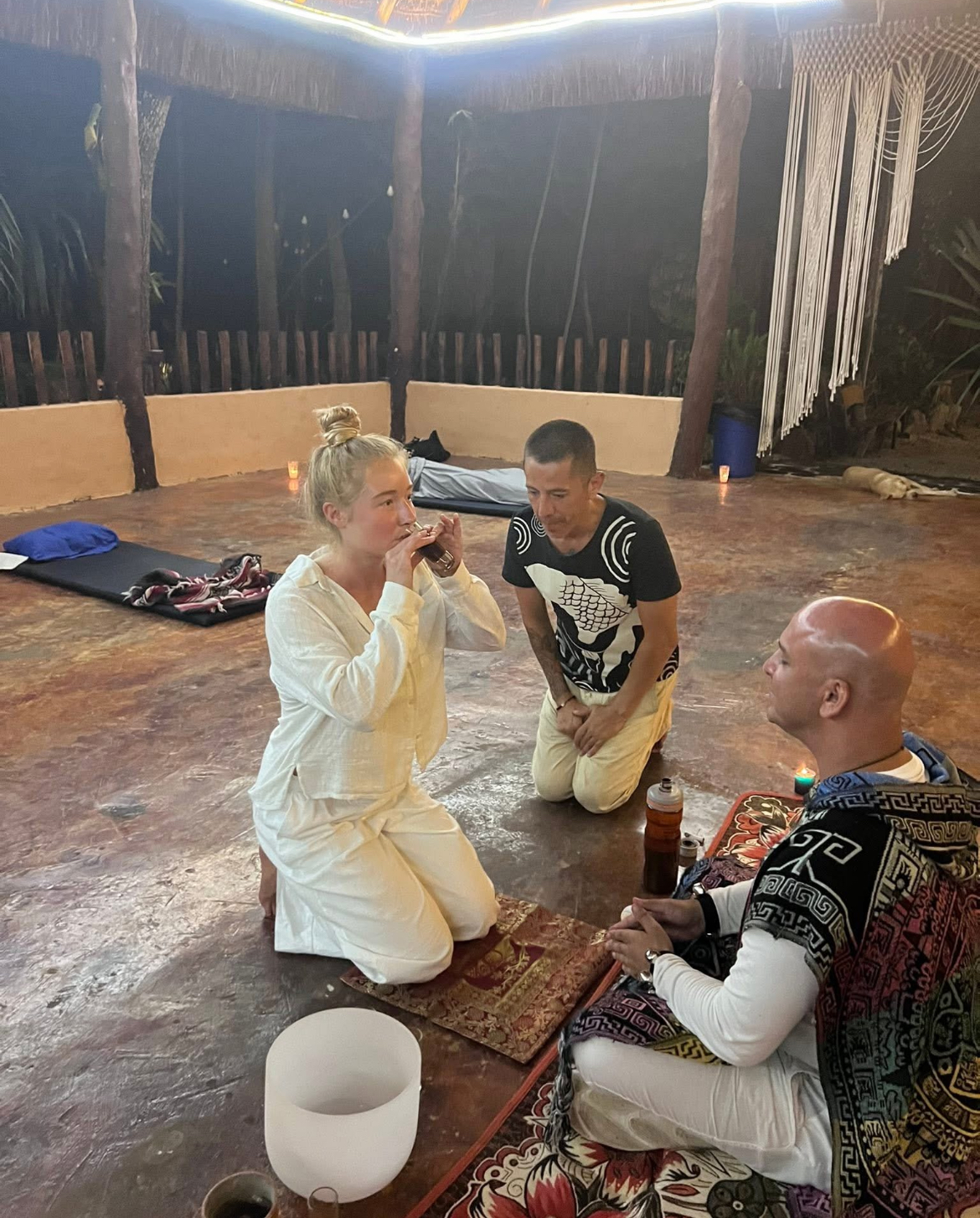
Our retreat center is located in a private jungle setting near Puerto Morelos and Cancún, Mexico.
For our ceremonies, we use ayahuasca sourced from the Pucallpa region of the Peruvian Amazon, an area with a rich history of traditional plant medicine practices.
Healing Ceremonies Mexico grew from our shared journey, experience with plant medicines, and belief that genuine transformation does not end with a ceremony.
Stanley – Traditional Plant Medicines & Ceremonial Practice
Stanley has been working with plant medicines for many years.
An important part of his journey took place in the Peruvian Amazon, near Pucallpa, where he studied directly with an experienced traditional healer, or curandero, in the rainforest.
During this time, he gained knowledge of ayahuasca, traditional Amazonian approaches, and the spiritual significance of working with plants.
His journey later continued in Mexico, where he further developed his knowledge and experience with other medicines, including Bufo Alvarius and sacred mushrooms.
His learning also included traditional Amazonian ceremonial songs, known as ícaros, which he studied under the guidance of a shaman.
These experiences have shaped his personal approach to ceremonial work, grounded in respect for the medicines, their traditions, and each participant’s individual journey.
Irena – Kundalini Yoga, Body Awareness & Integration
For Irena, working with plant medicines became part of a profound personal and spiritual transformation.
Her journey gradually led her toward deeper self-understanding, greater awareness of her emotions, fears, and learned patterns, and a more conscious relationship with herself and life.
An important part of her development has been Kundalini Yoga, which she studied and completed Level 1 Kundalini Yoga teacher training through the KRI system.
Through yoga, meditation, conscious breathing, and body awareness, she has deepened her understanding of the connection between the mind, emotions, and physical body.
Her personal journey brought her to an important realization:
A profound spiritual experience may bring new awareness, but genuine transformation requires us to gradually integrate that understanding into our bodies, our responses, and our everyday lives.
This connection between spiritual experience, embodied awareness, and conscious presence has become an essential part of her approach.
Irena focuses on supporting participants throughout their retreat experience and during integration. Through meditation, gentle yoga practices, body awareness, and personal conversations, she helps create space for people to explore their experiences and better understand the relationship between their emotions, thoughts, and physical responses.
Her approach is rooted in the understanding that spiritual growth is not only about the mind or extraordinary states of consciousness.
It is also about learning to remain present in our bodies, recognize automatic reactions, develop a more conscious relationship with fear, and gradually cultivate greater inner balance.
For Irena, integration is not simply about understanding what happened during a ceremony. It is about learning how to embody that understanding in everyday life.
Our Shared Philosophy
Our work brings together experience with traditional plant medicines, Kundalini Yoga, meditation, body awareness, meaningful conversations, and integration.
We work with small groups, allowing us to offer individual attention and respect each participant’s unique journey.
We believe that no medicine alone can resolve all of life’s difficulties.
It may offer an experience, a new perspective, or a profound realization.
But genuine change unfolds gradually — through our everyday choices, relationships, responses, and willingness to take responsibility for our lives.
Our intention is not simply to accompany participants during ceremonies, but also to support them in exploring how the meaning of their experiences can become part of everyday life.
Because the true spiritual path is not only about what we experience in extraordinary states of consciousness, but about how we learn to live with greater presence, love, humility, and awareness in our everyday lives.
With love and respect,
Irena & Stanley
Healing Ceremonies Mexico